Sunday, May 4, 2008

Batavia woman makes world more peaceful, one garden at a time

Mark Hare, Rochester Democrat and Chronicle

You never know when you plant a seed (or in this case, a tulip bulb), just what might grow.

Paula Savage lives in Batavia and works as director of tourism sales for Visit Rochester (formerly the Greater Rochester Visitors Association). Eighteen years ago, when she was living in Washington, D.C., and working to promote a higher profile (and more visitors) for the Canadian capital city of Ottawa, she had an idea. "I thought, 'Wouldn't it be a great idea if Ottawa gave some tulip bulbs to Washington for a peace garden?'"

Ottawa has been known for its tulips since its support for the exiled Dutch royal family during World War II. Queen Juliana gave birth to Princess Margriet in an Ottawa hospital, and after the war, Queen Juliana began to send thousands of bulbs to the Canadian city as a gesture of thanks.

"The Park Service loved the idea," she says, "and they drove me all around looking for sites." They settled on a spot near the Washington Monument and planted 4,000 bulbs, donated by the city of Ottawa.

That's when Savage decided on the next step, with a little encouragement from people she knew with connections to the Polish embassy.

"'Why stop it here?' I thought. 'Maybe we can do something to recognize other counties for peace efforts.'" The idea was an annual garden, designated for a new country each year by the previous winner. The United States selected Poland, which had just formed its own democracy. A year later, the second peace garden opened at Warsaw's Tomb of the Unknown Soldier.

There have been 18 countries recognized so far with gardens. The 19th will be in Kiev, Ukraine, later this year.

Savage is the founder and CEO of the International Peace Garden Foundation, which has never sought nor received substantial grants. The initial expenses all came out of Savage's pocket, and she travels to each garden dedication ceremony at her own expense. Ottawa continues to donate tulip bulbs each year.

But small doesn't mean ineffective. In 1992, on a business trip to Las Vegas, Savage was in a hotel lounge and struck up a conversation with the piano player, Tommy Deering. They talked about the tulip gardens, and "he said he'd create a symphony for the foundation. I didn't think too much about it, but two weeks later a tape came in the mail."

Deering said the foundation would be free to use the music any way it saw fit, but in exchange, he wanted the foundation to establish a scholarship fund for undergraduates in the arts.

He said his family had been too poor to send him to college, so he would like to help young people get the chance he never did.

Savage raised a small amount of money and held a competition in Washington, which was won by Henry Velasco, a 14-year-old Filipino-American piano player. His life's goal, he said, was to play at Carnegie Hall.

A short time later, Savage was in New York City, and she just walked into Carnegie Hall to "see if I could talk to someone." Four months later, Velasco performed at the famed theater, along with Deering.

Over time, the scholarship, still tiny, has evolved. The year the garden went to South Africa, she says, they used scholarship funds to create a Beads for Peace program to help poor women use resources readily available to them to make and sell jewelry to boost their standard of living. (Savage also makes her own line of jewelry and uses the proceeds for the foundation.)

"Ultimately," she says, "I'd like to hold a cultural Olympics — music, art, dance — for people from all the Peace Garden countries."

That will take time, but Paula Savage is sure it will happen. "The real message," she says, "is that you can change the world." Get a plan and get on with it.

Tuesday, December 25, 2007

Christmas 2007

Warm greetings and Happy Holidays to all. This spring our delegation traveled to Bern, Switzerland for the dedication of the 2007 International Peace Garden. Switzerland marks the 12th European country to be honored with an International Peace Garden. Mayor Alexander Tscfhappat hosted a magnificent event at the Erlacherhof, seat of the Mayor, following the formal dedication of the Peace Garden planted at the Universal Postal Union. Because of the many international affairs conducted there, Bern City Council chose this location. The reception was attended by many ambassadors of former Peace Garden countries and by representatives of international organizations based in Bern. Bern was chosen by Dublin mainly because of the neutrality of Switzerland, which allows this country to host sensitive conferences. Also, Bern actively participates in the Conference on Disarmament.

A special thanks to the Netherlands Ambassador for hosting a reception for our delegation at his private residence. Our delegation spent several days touring the city and surrounding areas. Bern, being one of the oldest capital cities in Europe, is a World Heritage Site and enjoys a rich history dating back to medieval times. The city has delightful character and it’s no wonder having a very contemporary mayor who chooses to travel to work daily by motorcycle.

Our mission is that the Peace Gardens will seek to inspire. We hope we have done just that with the students from Laubegg School in Bern who assisted with the actual planting of the Bern Peace Garden back in the fall of 2006. Today a world without borders is merely a vision. These children are our future. We hope by having them partake in this project, that it will help to make this vision a reality. While in Bern we were privileged to visit Laubegg School to conduct a Peace Studies Workshop for the very class who participated in the planting of the Peace Garden. Donna Lopez, our newly appointed Director of Education, coordinated this program. Director Ria Hudome and myself assisted with the execution. We hope to continue this practice with all future Peace Gardens.

Also in 2007, The International Peace Gardens became a major theme along the tulip route for the 2007 Skagit Valley Tulip Festival in Washington State. You can imagine our surprise when we first received the call from Jeannette DeGoede several months prior informing us that she was very inspired by our story and intended to create miniature Peace Gardens at Tulip Town honoring the many Peace Garden recipient countries. She did just that. Judging by the spectacular photos, the extensive media coverage and many thousands of visitors who came through the gardens through out the month-long festival Jeanette was simply overwhelmed. Her goal is to keep the theme alive year after year and to add to her exhibit as we continue to dedicate new Peace Gardens worldwide.

We look forward to the Peace Garden Dedication in Kiev, Ukraine next spring. We will hopefully be joined by a group of students and the principal from Hillside Academy in Temecula, CA. This school commissioned our official banner by renowned quilting artist Linda Sawrey back in 1996.

Peace to all and have a blessed and prosperous New Year!
Paula Savage
President

Friday, August 17, 2007

Preparations for 2008 Dedication

Greetings friends, preparations are underway for the dedication of the 2008 International Peace Garden -- Kiev, Ukraine. Stay tuned for details. Bern, Switzerland nominated Kiev during the 2007 dedication ceremonies.

Wednesday, April 4, 2007

Skagit Valley Tulip Festival is bursting with bulbs — and ideas

People who've seen the Skagit Valley in April will instantly recall the way the flat farmland is painted in broad swaths of red and yellow during the tulip bloom, one of the state's postcard tourist images.

But visitors this year may find fresh angles on this favorite day trip. Between a new attraction at one of the two big display gardens and the way the tulips appear in different fields due to crop rotation, you should be able to rekindle that feeling of "awww."

The newest attraction is an homage to the world's peace gardens, being inaugurated at Tulip Town.

Peace gardens began to sprout due to a friendship made during World War II. The heir to the Dutch crown, Princess Juliana, was whisked off to Canada to protect her from the war. After she returned safely to Holland, she sent Ottawa yearly thank-you gifts of thousands of tulip bulbs.

The practice caught on, and now the tulip torch of friendship is passed from one country to another each year; there are now 16 gardens in capitals around the world. The U.S. peace garden is across from the Holocaust Museum in Washington, D.C.

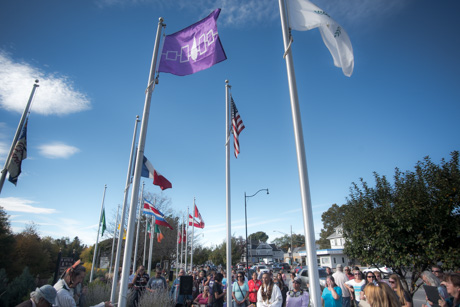
"We thought, it is such a beautiful thing, we're going to represent all 16 countries with a garden," says Jeannette DeGoede, owner of Skagit Valley Bulb Farm, which operates Tulip Town on Bradshaw Road. In the new, half-acre garden, each country is represented by a flag; a series of arches will connect them. A mass of tulips, hyacinths and anemones will bloom beneath the flags in a red, white and blue design.

The farm is inaugurating a new tulip exclusively for the peace garden. "It's dark red with a white edge," says DeGoede, "and will bloom with anemones in soft purple and white, and over 10,000 grape hyacinths, planted in sweeping bands."

Those broad swaths of color across the tabletop landscape are what draw the crowds. Even among returning visitors, "many people comment that it's all new," says Washington Bulb Company president Leo Roozen.

Traveling tulips

The active tulip fields are moved to new land each year in a rotation to rest the soil, making the perspective change each season.

"One time, you're shooting pictures to the West, next time you have Mount Baker as your backdrop, or straight to the east, and you're seeing the Cascades," Roozen says. "On clear days, if you're shooting in the right direction, you have the Olympics in the background."

Anyone with a good eye and a long lens will tell you that the white-capped crags of our local peaks make a stunning backdrop to the bright, curvaceous tulips.

New varieties are introduced in his Roozengarde display gardens on Beaver Marsh Road each year, Roozen says, but "when you have hundreds of acres of tulips and a few feet of a new variety, people don't even notice it." Besides, he says, it might be best not to single out the new entries, because they could become victims of eager hands. "People say, 'Hey, I've gotta have one of these.' It's human nature."

That is experience talking. Roozen's family has been in the tulip business for 35 years, and he recalls walking the fields as a young boy with his dad. "He was topping off a row of tulips, and he left one," Roozen recalls. "I topped it off and ran up and said, 'You left this.' Of course, he had left it on purpose."

Shooting pictures of the flowers and resisting the urge to pick are not the only pastimes in the Skagit Valley during the tulip bloom. At the annual Skagit Valley Tulip Festival, which runs through April 30, there are art shows, an air show, a street festival in Mount Vernon, a fundraising bike tour and many other attractions and events. "A lot of these activities are free, and you can take the family," says DeGoede.

In recent years, the fields have been made more accessible, she says. At Tulip Town, along with improving wheelchair accessibility, handrails have been added for safety on the uneven farm ground. You can also replace a walking tour completely by riding a trolley that loops the colorful fields.

If you are on foot, though, you may be able to answer a common visitor question: "How many tulips are in the fields?" Not an easy bit of math, because "we have some fields that are a half-mile long, some only an eighth of a mile," says Roozen. But he does offer an equation: "Take the size of your foot, count the plants next to it, and then start walking and multiplying." Foot times plants times steps may equal the number of flowers in a row, but the total bulb count will still be elusive. "There's more than one bulb per plant," he says. In the end, this is his only speculation: "There's a lot."

If you don't believe him, go see it for yourself.

Sunday, April 1, 2007

2007 Peace Garden Dedication in Bern, Switzerland

The 2007 International Peace Garden will be dedicated in Bern, Switzerland during a gala ceremony hosted by Mayor Alexander Tschappat on Thursday, May 3rd,2007.

During the 2006 Peace Garden Dedication in Dublin, Ireland Bern was nominated by then Lord Mayor Catharine Byrne.

Switzerland is being honored for her strong humanitarian tradition and contributions to the development of international good practice. Mayor Byrne pointed out that Switzerland’s key foreign and development policy objectives include alleviating hardship and fighting poverty alongside fostering the peaceful coexistence of peoples, promoting respect for human rights, democracy and preserving natural resources.

More than half of the recipient countries of the International Peace Gardens are members of the European Union. The International Peace Gardens offer a lasting link for participating countries and capital cities to open doors for trade, commerce and cultural exchange.

Annually, the Foundation co-ordinates the passing of the Peace Garden to a capital city, guided by a nomination put forth by the preceding year's recipient.

Canada initiated the dedication of the first Peace Garden, which is now making its way around the world in a multi-cultural chain of global friendship. At each peace garden a permanent stone marker is placed with this inscription “Let the seeds of peace begin here and spread through out the world.”

The International Peace Garden Foundation, based in the United States, is a charitable volunteer organization established in 1992. Our mission is to celebrate the achievements made by countries toward peace and democracy. We strive to give youth the opportunity to learn, to help others and broaden their knowledge of world cultures. We offer a unique mechanism for capital cities to trade ideas for fostering non violence, public safety, conflict resolution and at the same time build bridges for foreign trade. Participating countries include Canada, USA, Poland, Hungary, France, Slovenia, South Africa, Mozambique, Costa Rica, Netherlands, Japan, Austria, Italy, Greece, Cyprus, Ireland and now Switzerland.

Last fall students of 26 students from Laubegg School participated in the planting of the Bern Peace Garden. These children will be on hand for the dedication on May 3rd.

Friday, December 15, 2006

2006 Holiday Greetings

Holiday greetings to all our dear friends across the miles. This past April, Dublin, Ireland celebrated the dedication of our seventeenth International Peace Garden. Ireland opened her doors to us and touched our hearts profoundly. We were fortunate to be able to tour the country for several days prior to our arrival in Dublin. From the breathtaking vistas of the Dingle Peninsula to the multi-colored doors of Dublin we were astounded by the culture and endless beauty of Ireland. Being able to visit the town folk in the hillside villages and share our story made our journey that much more enduring.

Lord Mayor Byrne assisted by her exceptional staff extended the cities warm hospitality to our entire delegation which included IPGF directors Ria Hudome from London and Paul Golunski from Paris. Dublin was ours to discover and that we did. We were introduced to Glencree, a center for the study of conflict resolution, mediation and peacemaking. Our visit to Glencree Centre was truly a highlight. We applaud their mission and consider Glencree to be an outstanding model for similar initiatives. It is their hope that some day an Honorary Peace Garden will bloom there. Our sincere appreciation to Bernice Paolozzi and her associates for organizing these activities and for their time and attention afforded to us during our stay.

The Peace Garden dedication held in St. Patrick's Park was flawless. The Municipal Parks Department designed the Peace Garden in a rainbow of colors. It is their intention to replace the tulip bulbs with seasonal flowers to extend the length of time visitors will be able to enjoy its beauty. Delegates representing many countries including multi -faith religious leaders stood side by side as the RTE Corn a nOg Children's Choir performed. Children from Down Syndrome Ireland took pride in seeing the bulbs they had planted earlier in the Fall actually bloom In her welcoming comments Mayor Byrne expressed that "young people through their enthusiasm and vibrancy break down barriers and encourage tolerance and hope for our future". Other youth organizations in attendance were Peace Child Ireland and Chernobyl Children's Project International. Our volunteers continue to offer their time and talents. We gratefully acknowledge their efforts. We also express our sincere appreciation to Lakefront Tours, Cleveland, Ohio for their generous donation to our 2007 program.

We look forward to the Peace Garden Dedication in Bern, Switzerland next May. Mayor Alexander Tschappat has informed us that a planting ceremony took place on November 29th. The bulbs were planted by school children from Bern assisted by adult volunteers.

Howard Thurman once wrote that the work of Christmas is "to find the lost, to heal the broken, to feed the hungry, to release the prisoner, to rebuild nations, to bring peace among brothers and to make music in the heart". May you and your loved ones discover the true meaning of this blessed holiday season. We are proud to know you. You remain in our thoughts and prayers.

Have a blessed and prosperous New Year!

Paula Savage

Sunday, November 19, 2006

The Rome Declaration of Noble Peace Laureates

The 7th World Summit of Nobel Peace Laureates took place in Rome from November 17 to 19 and was held, as were previous Summits, on the initiative of Mikhail Gorbachev and the Mayor of Rome, Walter Veltroni.

They produced this declaration:


We, Nobel Peace Laureates and Laureate Organizations, gathered in Rome, Italy, have for years been deeply disturbed by the lack of public attention and political will at the highest levels of state paid to the need to eliminate nuclear weapons. There are over 27,000 of these devices threatening civilization, with over 95% in the hands of Russia and the US. This danger threatens everyone and thus every person must work to eliminate this risk before it eliminates us.

We oppose the proliferation of nuclear weapons to any state. We are faced each day with a new crisis in proliferation exemplified by concerns regarding North Korea and Iran. However, our focus must be on the weapons themselves for the only sustainable resolution to gain security is the universal elimination of the weapons.

The failure to address the nuclear threat and to strengthen existing treaty obligations to work for nuclear weapons abolition shreds the fabric of cooperative security. A world with nuclear haves and have-nots is fragmented and unstable, a fact underscored by the current threats of proliferation. In such an environment cooperation fails. Thus, nations are unable to address effectively the real threats of poverty, environmental degradation and nuclear catastrophe.

Nuclear weapons are more of a problem than any problem they seek to solve. In the hands of anyone, the weapons themselves remain an unacceptable, morally reprehensible, impractical and dangerous risk. The use of a nuclear weapon against a state without nuclear weapons is patently immoral. Use against a state with nuclear weapons is also suicidal. These weapons have no value against terrorists or criminals. Progress toward a safer future is not thwarted from a lack of practical, threat-reducing policy options. The problem is a lack of political will.

As Nobel Peace Prize Laureates we commit to work collectively to achieve the elimination of nuclear weapons, which we believe are unworthy of civilization.

We have heard the impassioned warning from the Mayor of Hiroshima and survivors of the atomic bombs and join him and the over 1500 cities around the world, including Rome, in their call to all nations, including those with nuclear weapons arsenals – US, Russia, France, China, UK, Israel, India, and Pakistan – to immediately commence negotiations to obtain the universal, legally verifiable elimination of nuclear weapons. In past years we have set forth practical steps to bring us to such a better world, and we reiterate the need for such policies as a entry into force of the Comprehensive Test Ban Treaty, de alerting of the hair trigger launch on warning arsenals of thousands of hazardous weapons deployed now by Russia and the US, obtain stricter IAEA controls over nuclear materials, and pledges never to use a nuclear weapon first. Such efforts will help to ensure that nuclear capabilities are denied to terrorists.

We issue a serious warning that without such efforts the Nuclear Test Ban Treaty (NPT) could corrode opening the way for dozens of states to become nuclear armed, a frightening prospect. The NPT is a bargain in which nonproliferation is obtained based on a promise by nuclear weapons states to negotiate nuclear weapons elimination and offer peaceful uses of nuclear technology. There is a fundamental dilemma which must end. Nuclear weapons states want to keep their weapons indefinitely and at the same time condemn others who would attempt to acquire them. Such flaunting of disarmament obligations is not sustainable.

The current situation is more dangerous than during the Cold War. We are gravely concerned regarding several current developments such as NPT stakeholders enabling rather than constraining proliferation, modernization of nuclear weapons systems, the aspiration to weaponize space, thus making arms control and disarmament on earth all the more difficult, and the declared policy of terrorist organizations to obtain nuclear weapons.

Given the critical nature of the situation, we pledge to challenge, persuade and inspire Heads of State to fulfil the moral and legal obligation they share with every citizen to free us from this threat. We declare our intention to participate fully in a world summit where leaders of culture, arts, sciences, business, and politics, will actively participate.

As Nobel Peace Laureates, conscience requires us to raise our voices, inspire humankind, and to demand change in state policies. We call upon the citizens of the world to join us in this work.


2006 Acknowledgement of the Man of Peace

The ceremony of the acknowledgement of Man of Peace 2006 took place before the opening of the Summit. It was awarded to Peter Gabriel.

The Summit was openend by Walter Veltroni, Lech Walesa and Mairead Corrigan Maguire. Those taking part in the Summit were: Frederik Willem De Klerk, Mairead Corrigan Maguire, Lech Walesa, Carlos Filipe Ximenes Belo, International Atomic Energy Agency, International Physicians for the Prevention of Nuclear War, International Peace Bureau, United Nations Organization, United Nation High Commissioner for Refugees, United Nations Children’s Fund, International Labour Organization, Mèdecins sans Frontières, American Friends Service Committee, Red Cross, International Campaign to Ban Landmines, Pugwash Conference. Guests of honour were: Mayor of Hiroshima and President of the World’s Mayors for Peace Tadatoshi Akiba, Nobel Laureate for Medicine Rita Levi Montalcini, Man of Peace 2006 Peter Gabriel, Representative of the Weapons of Mass Distruction Commission Jayantha Dhanapala, President of the Foundation on Economic Trends and Greenhouse Crisis Foundation Jeremy Rifkin, Under-Secretary-General of the United Nations Nobuaki Tanaka and Under-Secretary-General of the United Nations Jose Antonio Ocampo.